



A 90-day SEO roadmap is a three-phase plan that takes a startup website from zero to steady organic growth: 30 days to fix the foundation, 30 days to build content and pages that convert, and 30 days to earn authority and scale what already works. The order matters more than the tactics. Content on a broken site leaks, and links to weak pages get wasted.
Most startups don’t have an SEO problem. They have a sequencing problem. They publish random blog posts in week one, ignore technical issues, check rankings in week six, and then quit because nothing moved.
After 7+ years doing SEO and digital marketing, this is the exact 90-day SEO roadmap I build for startups from scratch. You can copy it, adapt it, and use the checklist at the end to track progress.
Key Takeaways
- ✅ A 90-day SEO roadmap runs in three phases: Foundation (days 1–30), Build (days 31–60) and Grow (days 61–90).
- ✅ Fix technical issues and set up tracking before publishing new content.
- ✅ Optimize money pages first, then build two focused topic clusters.
- ✅ Use days 61–90 for backlinks, quick-win refreshes and AEO for AI search.
- ✅ Track indexed pages, impressions, top 10 keywords and organic signups, not vanity traffic.
In This Guide
The 90-Day SEO Roadmap at a Glance
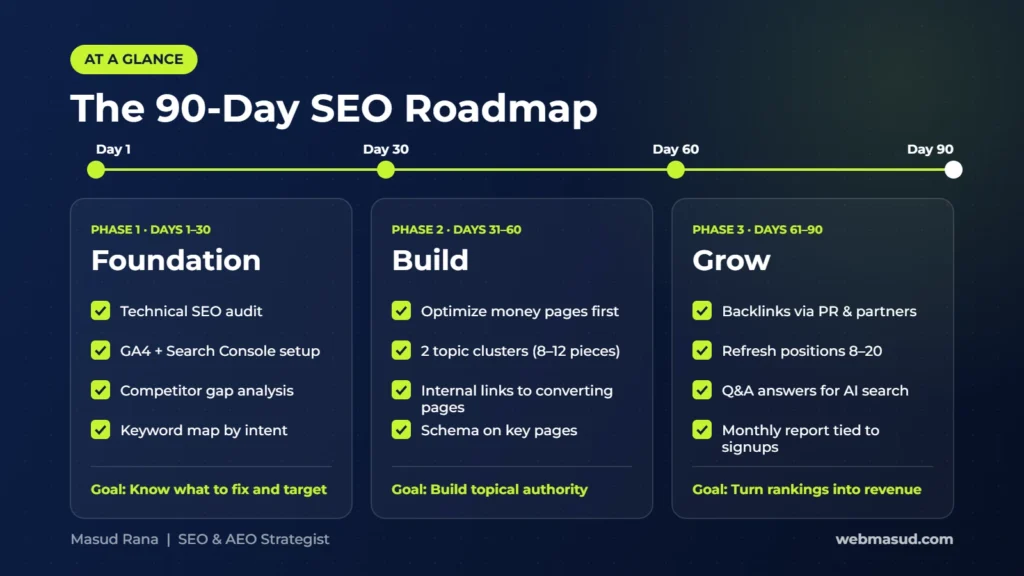
Here is the whole plan in one view. Each phase builds on the one before it, so resist the urge to skip ahead.
| Phase | Days | Focus | Key outcome |
|---|---|---|---|
| Foundation | 1–30 | Technical audit, GA4 + Search Console, competitor gaps, keyword map | A prioritized fix list and a keyword map |
| Build | 31–60 | Money pages, two topic clusters, internal links, schema | Optimized core pages and 8–12 focused pieces |
| Grow | 61–90 | Backlinks, refreshing pages in positions 8–20, AEO, reporting | Rankings and traffic tied to signups |
Why Most Startup SEO Fails
Before the 90-day SEO roadmap itself, it helps to know what goes wrong. In almost every startup site I audit, I see the same four patterns:
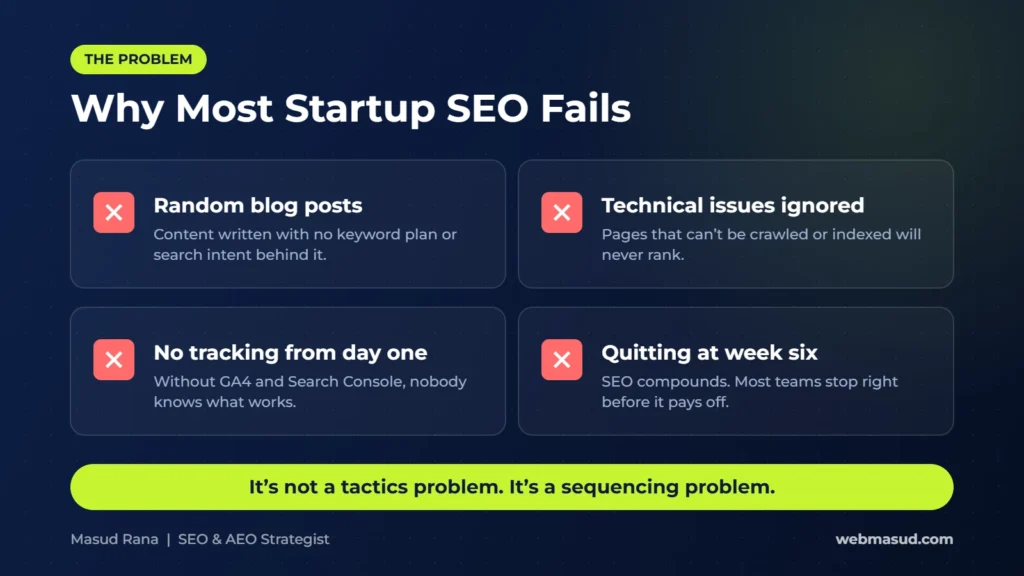
- Random blog posts with no keyword plan. Content gets written around what the team finds interesting, not what customers search for.
- Technical issues ignored. Pages that can’t be crawled or indexed will never rank, no matter how good the content is.
- No tracking from day one. Without Google Search Console and GA4 set up properly, you can’t tell what’s working.
- Quitting at week six. SEO compounds. Most of the payoff shows up after the foundation is in place, which is exactly when impatient teams stop.
None of these are tactics problems. They are order-of-operations problems, which is why I always separate SEO strategy from SEO tactics before touching anything.
Days 1–30: Foundation (Fix the Base Before You Build)
The goal of the first month of your 90-day SEO roadmap is simple: know exactly what to fix and what to target. No new content yet.
1. Run a technical SEO audit
Crawl the whole site with a tool like Screaming Frog or Sitebulb. Check that important pages are indexable, that there are no accidental noindex tags or robots.txt blocks, that redirects aren’t chained, and that your XML sitemap only lists pages you want ranked. Then check page experience: Google explains how it measures loading, interactivity and visual stability in its Core Web Vitals documentation.
2. Set up GA4 and Google Search Console properly
Verify the domain property in Search Console, submit the sitemap, and connect it to GA4. Set up conversion events for the actions that matter to a startup: signups, demo requests, trial starts. If you can’t tie organic traffic to signups, you can’t prove SEO is working.
3. Do a competitor gap analysis
Pick three to five competitors that already rank for your core terms. Look at which pages bring them traffic, which topics they cover that you don’t, and where their content is thin. Those gaps become your fastest opportunities.
4. Build a keyword map by search intent
Group keywords into clusters and assign each cluster to one page. Separate commercial intent (pricing, comparisons, “best X for Y”) from informational intent (how-to and guides). Search volume alone is misleading here; I explain why in keyword search volume vs intent.
End of month one, you should have: a prioritized fix list, working analytics, a competitor gap list, and a keyword map that tells you exactly which page targets which query.
Days 31–60: Build (Content and Pages That Convert)
Month two of the 90-day SEO roadmap is about building topical authority Google can trust, starting with the pages closest to revenue.
1. Fix and optimize money pages first
Your homepage, product pages, pricing page and core service pages come before any blog post. Tighten title tags and meta descriptions, match each page to one search intent, improve headings and copy, and make the next step obvious.
2. Publish two topic clusters (8–12 focused pieces)
Instead of 30 scattered articles, pick two topics your buyers care about. For each one, create a pillar page plus supporting articles that answer the specific questions around it. Depth on two topics beats a thin layer across twenty.
3. Build internal links to pages that convert
Every supporting article should link to its pillar page, and pillar pages should link to the relevant money page. Internal links tell Google what matters most on your site and guide readers toward signing up.
4. Add schema markup to key pages
Use Organization schema site-wide, Article schema on blog posts, FAQ schema where you answer real questions, and Product or SoftwareApplication schema where it fits. Structured data helps both search engines and AI systems understand who you are and what you offer, which ties directly into entity SEO.
Days 61–90: Grow (Scale What Is Already Working)
By month three of your 90-day SEO roadmap, you have data. Now the goal is to turn rankings into revenue.
1. Earn backlinks through PR and partnerships
Skip low-quality link buying. Pitch founder stories and original data to industry publications, get listed on integration and partner pages, and contribute expert quotes. A handful of relevant links to your strongest pages beats dozens of random ones.
2. Refresh pages ranking in positions 8–20
Open Search Console and filter for queries where you sit on page one’s bottom or page two. These pages are close. Improve the content, add missing subtopics, strengthen internal links, and update the title to match the query better. This is often the fastest traffic win in the whole roadmap.
3. Add clear Q&A answers for AI search (AEO)
Buyers now ask ChatGPT, Perplexity and Google’s AI Overviews before they ever click a link. Add short, direct answers to the questions your customers ask, structure them with clear headings, and back them with FAQ schema. My complete Answer Engine Optimization guide covers this in depth.
4. Send a monthly report tied to signups
Report on what moves the business, not vanity numbers. Show which pages brought organic signups, what changed this month, and what the plan is for next month.
What to Track: Measure Progress, Not Vanity
Check these four numbers weekly and report them monthly:
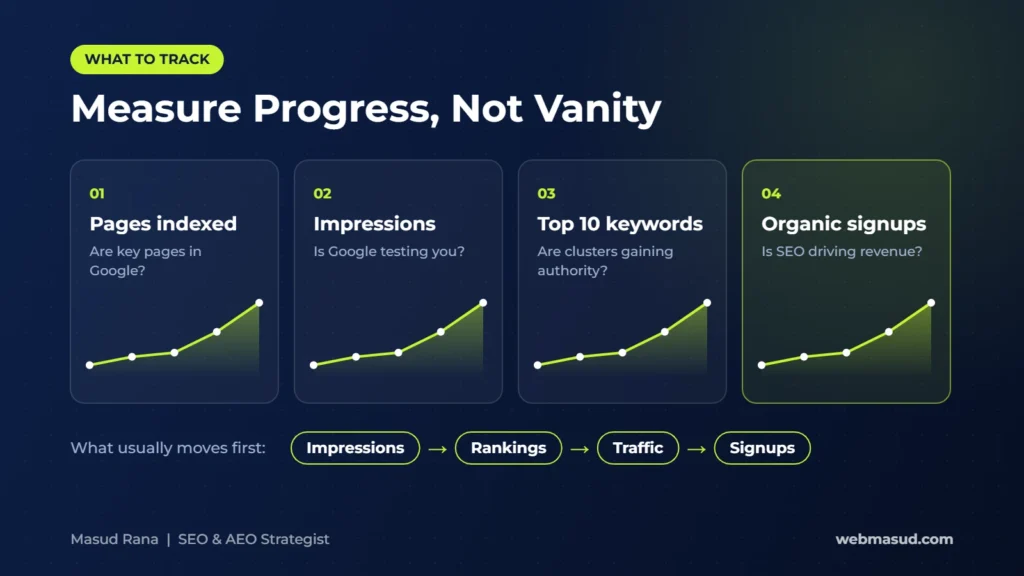
- Pages indexed: are your important pages actually in Google’s index?
- Impressions in Search Console: the earliest sign that Google is testing your pages.
- Keywords in the top 10: shows whether your clusters are gaining authority.
- Organic signups and leads: the only number your CEO really cares about.
Impressions usually move first, then rankings, then traffic, then signups. If impressions grow but clicks don’t, work on titles and meta descriptions. If traffic grows but signups don’t, the problem is on the page, not in Google.
The Rule: The Order Matters More Than the Tactics
Every tactic in this 90-day SEO roadmap is well known. What makes it work is the sequence:
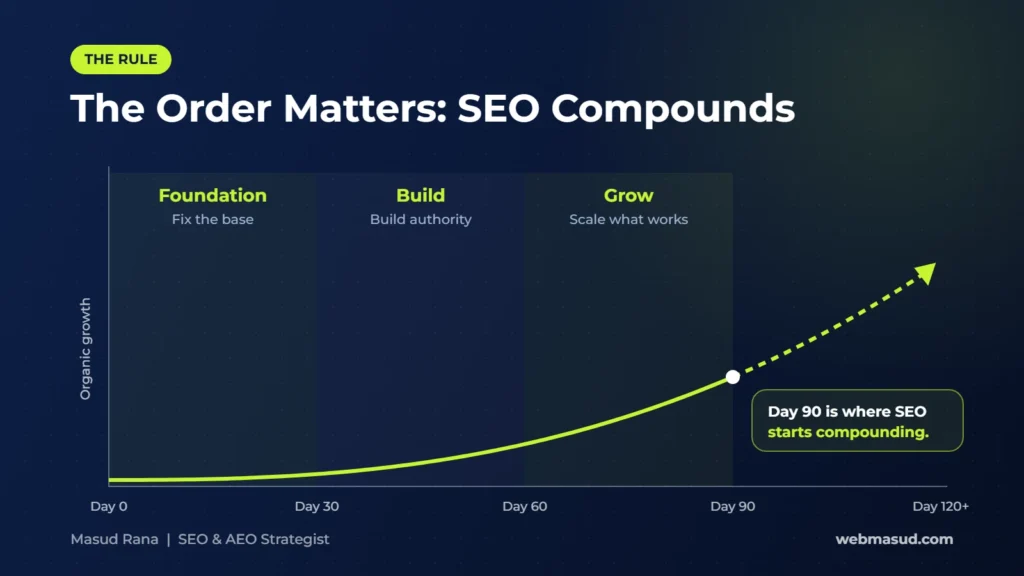
- Content on a broken site leaks, so the foundation comes first.
- Links pointing at weak pages get wasted, so pages get built before authority.
- Scaling without data is guessing, so growth comes last.
Day 90 isn’t the finish line. It’s where SEO starts compounding.
Your 90-Day SEO Roadmap Checklist
Days 1–30: Foundation
- Technical audit: crawl, indexing, Core Web Vitals
- GA4 + Search Console set up with conversion events
- Competitor gap analysis
- Keyword map by search intent
Days 31–60: Build
- Fix and optimize money pages first
- Two topic clusters, 8–12 focused pieces
- Internal links to pages that convert
- Schema markup on key pages
Days 61–90: Grow
- Earn backlinks through PR and partnerships
- Refresh pages ranking in positions 8–20
- Add clear Q&A answers for AI search (AEO)
- Monthly report tied to signups
Want This Roadmap Built for Your Startup?
If you’d rather have an expert run this plan with you, I help startups and online businesses build SEO and AEO systems that bring in customers, not just traffic. Take a look at my SEO services or get in touch to talk about your 90 days.
Frequently Asked Questions
How long does SEO take for a startup?
Most startups see early signals like more impressions and indexed pages within the first one to two months. Meaningful traffic and signups usually build from month three onward, once the technical foundation and core content are in place. Competitive industries can take longer.
What should a startup do first in SEO?
Start with the foundation: a technical audit, proper GA4 and Google Search Console setup, a competitor gap analysis, and a keyword map by search intent. Publishing content before fixing crawl and indexing issues wastes effort.
How many blog posts does a startup need for SEO?
Quality and focus matter more than volume. Two well-planned topic clusters of 8 to 12 focused pieces, linked to your money pages, usually outperform dozens of unrelated articles.
Is a 90-day SEO roadmap enough to rank on Google?
90 days is enough to fix the foundation, build core pages and content, and start earning authority. It is the starting point, not the finish line. SEO compounds, so results keep growing when you continue the cycle after day 90.
What is the difference between SEO and AEO in this roadmap?
SEO helps your pages rank in traditional search results. AEO (Answer Engine Optimization) helps AI tools like ChatGPT, Perplexity and Google AI Overviews understand and cite your content. The roadmap adds AEO in days 61–90 with clear Q&A answers and FAQ schema.
About the Author
Masud Rana is an SEO and AEO strategist with 7+ years of experience in SEO and digital marketing. He helps startups and online businesses rank on Google and get cited by AI search tools like ChatGPT, Perplexity and Google AI Overviews. More about Masud or connect on LinkedIn.