



A marketing director at a mid-size logistics company opens ChatGPT and types: “Which agencies can help a B2B logistics company recover lost organic traffic?”
The answer names three agencies, explains what each one does, and suggests what to ask them on a first call.
Your agency does exactly this work. You have the case studies to prove it. But you are not in the answer, and you will never know that conversation happened.
That is the new visibility problem. It is not only about where you rank. It is about whether AI systems can understand what your business does well enough to describe it, recommend it, or cite it.
ChatGPT can understand what your business does only as well as the information available to it. AI search tools build their picture from your website, structured data, and what credible third parties say about you, and each tool gathers and weighs that information differently. If your positioning is vague, your services are loosely described, or your details conflict across sources, AI may miscategorize you, confuse you with another brand, or leave you out of relevant answers. Clear, specific, consistent, and verifiable information is the foundation of AI search visibility.
Why ranking on Google is no longer the whole picture
For two decades, search visibility meant one thing: appear on page one for the right keywords. The buyer clicked, read your page, and formed their own opinion.
AI-powered search changes the order of events. Tools like ChatGPT search, Perplexity, Gemini, Microsoft Copilot, and Google’s AI Overviews and AI Mode often read the sources first and hand the buyer a summary. The shortlist can form before anyone visits your website.
That creates a gap traditional SEO reports do not show. You can rank well for a keyword and still be described inaccurately, compared unfavourably, or skipped entirely when someone asks an AI tool a question in your category.
Google rankings still matter. They are just no longer the only place your reputation is formed.
How AI systems understand a business
There is no single “AI algorithm” deciding how your business is described. Different tools work differently, and the same tool can behave differently depending on whether it searches the web for a given question.
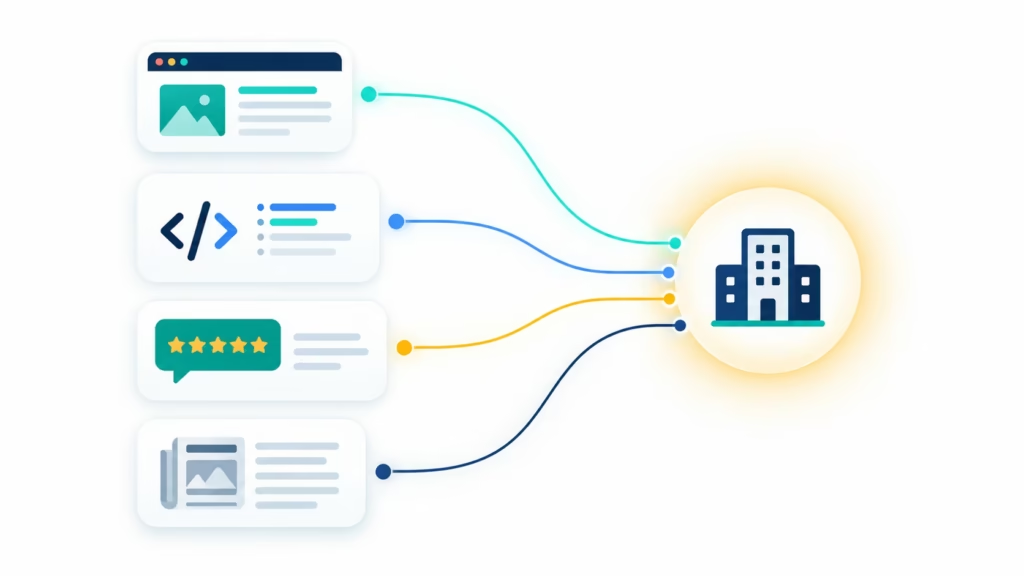
Two ways an AI tool can “know” you
- From what the model learned during training. A language model absorbs patterns from a large body of text collected up to a certain date. What it knows about your business this way may be thin, out of date, or missing, especially for smaller or newer companies.
- From what it retrieves at the moment of the question. Many AI search experiences look things up live, read the pages they find, and build an answer from them. Here, what your pages say today matters directly.
Each tool has its own way of retrieving information. OpenAI, for example, documents a separate crawler, OAI-SearchBot, for ChatGPT’s search features, and says sites that opt out of it will not be shown in ChatGPT search answers (OpenAI crawler documentation). Google says AI Overviews and AI Mode may use different models and techniques, and may run several related searches across subtopics to build a response (Google Search Central).
The practical takeaway: a tool can only use what it can reach and understand. Assumptions that hold for one tool will not always hold for another.
The signals AI draws on
Whichever route a tool takes, the raw material tends to come from the same places:
- Your website: homepage, service and product pages, About page, case studies, and articles.
- Structured data: schema markup that states plainly what kind of organization you are, what you offer, and which profiles belong to you.
- Third-party sources: directories, review platforms, industry publications, partner pages, interviews, and social profiles.
- Consistency across all of them: whether these sources agree on your name, category, location, services, and audience.
From these signals, AI forms what SEO professionals call an entity: a distinct, identifiable “thing” with attributes. For a business, that means what it is, what it does, who it serves, where it operates, and how it differs. Entity SEO is the work of making that picture clear and well supported.
Here is the mindset shift that matters most: AI cannot ask you a follow-up question. On a sales call, you can clarify what you meant. An AI system works only with what is written, structured, and confirmed somewhere it can find.
Why AI may misunderstand your business
Most AI misunderstandings trace back to problems that already existed on the website. AI simply makes them more visible.
- Vague website copy. “We help ambitious brands unlock growth” could describe an ad agency, a consultancy, a SaaS tool, or a coach. If a human cannot tell what you sell from your headline, an AI system cannot either.
- Unclear service descriptions. One page listing fourteen services in a single line each gives no tool enough detail to know which ones you are actually strong in.
- Inconsistent brand information. Your website says “B2B SaaS SEO”, your LinkedIn says “full-service digital agency”, and an old directory listing still says “web design”. AI has to pick one, or blend them into something inaccurate.
- Weak entity signals. No clear About page, no named founders or team, no consistent legal or trading name, and no links between your website and your official profiles. This is especially risky when your brand name is shared with other companies.
- Missing context. You never state which industries you serve, which regions you cover, what size of client you work with, or how you deliver the work.
- Poorly structured content. Key details hidden in images, sliders, PDFs, or collapsed tabs. Pages without clear headings. Important facts that appear nowhere in plain text.
Traditional SEO vs AI search visibility
Traditional SEO and AI search visibility overlap heavily, but they measure success differently.
Traditional SEO | AI search visibility | |
|---|---|---|
Core question | Does my page rank for this query? | Does AI describe my business accurately, and include it when relevant? |
Unit of success | A ranking position and a click | A correct description, a mention, or a cited source |
What gets evaluated | Individual pages against keywords | Your business as an entity, across many sources |
Typical failure | Ranking on page three | Being described wrongly, confused with another brand, or left out |
How you check | Rank trackers, Search Console | Asking AI tools directly and reviewing the sources they cite |
The two are not rivals. Google states that SEO fundamentals remain worthwhile for its AI features and that no special optimization or special schema is required to appear in them (Google Search Central). Crawlable, well-structured, helpful pages are still the foundation. AI search visibility adds a second question on top: once a system finds you, can it understand and verify what you do?
That is where answer engine optimization (AEO) and generative engine optimization (GEO) come in. AEO focuses on making your content easy to extract as a direct answer. GEO focuses on how your business is represented inside AI-generated responses. Both depend on clarity first.
Signs AI doesn’t understand your business
These are realistic patterns to look for when you test AI tools:
- Miscategorized. A B2B invoicing platform is described as “an accounting firm” because its homepage talks about “financial services for growing companies”.
- Linked to the wrong services. An agency that stopped building websites years ago is still described as a web design studio, because old portfolio pages and directory listings say so.
- Confused with another brand. A company shares its name with a business in another country, and AI blends details from both.
- Wrong location or audience. A firm that serves enterprise clients across Europe is described as a local small-business provider.
- Outdated facts. Old pricing, a former founder, or a discontinued product appears in answers.
- Generic description. AI describes you in words that would fit any competitor, with nothing about what makes you different.
- Missing from category recommendations. When asked for options in your category, AI names competitors but not you, even though you are an established provider.
Any one of these is a signal. Several together usually point to a positioning or consistency problem, not a technical one.
How to improve your AI search visibility
There is no switch that guarantees AI will mention you. What you can control is how easy your business is to understand, distinguish, and verify. This nine-part framework covers the essentials.
1. Make your positioning impossible to misread
Try completing this sentence without jargon:
[Business] is a [category] that helps [specific audience] [achieve a specific outcome] by [how you do it], unlike [the usual alternative].
If you cannot finish it, AI cannot either. Once you can, put that idea, in plain words, near the top of your homepage and About page.
2. Describe services and products specifically
For each core offer, state what it is, who it is for, what is included, what the client receives, and how it differs from similar offers. “SEO services” tells AI very little. “Technical SEO audits for Shopify stores with more than 1,000 products” tells it a great deal.
3. Give important services and audiences their own pages
One page per core service, and one page per key audience or industry where the offer genuinely differs. Dedicated pages give AI a clear, quotable source for each topic instead of a crowded overview.
4. Keep business information consistent everywhere
Audit how your business is described across your website, Google Business Profile, LinkedIn, industry directories, review platforms, and partner pages. Align your name, category, description, location, services, and founder or leadership details. Update or remove outdated listings where you can.
5. Add relevant structured data
Schema markup states facts in a machine-readable format. Useful types often include Organization (or a more specific subtype such as ProfessionalService or LocalBusiness), Service, Product or SoftwareApplication, Person for founders and authors, and Article for blog content. Use the sameAs property to connect your website to your official profiles.
Google says Organization markup on your home page can help it understand your organization’s details and distinguish it from others in search results (Google Search Central). Keep expectations realistic: structured data clarifies, it does not guarantee inclusion, and it must match what is visible on the page.
6. Build a logical site architecture with strong internal links
Group related pages, link service pages to supporting case studies and articles, and link back from articles to the relevant service. A clear structure helps both crawlers and AI systems understand how your expertise fits together. Google lists internal linking among the fundamentals that still matter for its AI features.
7. Publish original content that proves expertise
Explain how you work, the trade-offs you see, and the mistakes you help clients avoid. Share real examples and data you can stand behind. Content that only repeats what every competitor says gives AI no reason to associate a topic with you specifically.
8. Earn credible third-party mentions
What others say about you helps confirm what you say about yourself. Client reviews, partner listings, industry publications, podcast appearances, and conference talks all add independent signals. Focus on relevance and credibility, not volume.
9. Test how AI tools describe you, regularly
Ask several AI tools about your business, record the answers, and look at the sources they cite. Also check your robots.txt: if you block the crawlers a tool relies on for search, it may be unable to reach your pages at all.
A practical AI visibility audit
Run these questions in ChatGPT (with search on and off), Perplexity, Gemini, Microsoft Copilot, and Google’s AI Mode. Replace the brackets with your details.
Identity
- “What is [Business Name]?”
- “What does [Business Name] do, and who is it for?”
- “Where is [Business Name] based, and which markets does it serve?”
Services and audience
- “What services or products does [Business Name] offer?”
- “What kind of clients does [Business Name] usually work with?”
Differentiation
- “What makes [Business Name] different from [Competitor]?”
- “What are the strengths and weaknesses of [Business Name]?”
Category visibility
- “Which companies offer [your service] for [your audience] in [your market]?”
- “What are good alternatives to [Competitor]?”
Accuracy and sources
- “Where did you find this information about [Business Name]?”
- Are any facts outdated, blended with another company, or simply wrong?
Score each answer as accurate, partly accurate, wrong, or missing, and note which sources were cited. Those sources show you exactly which pages and profiles are shaping your reputation.
Expect variation. Results can differ by tool, by whether web search was used, by the user’s location and account settings, and over time as tools and sources change. Run the audit more than once, and repeat it every few months rather than treating one answer as the final verdict.
A realistic example: vague vs clear
Consider a hypothetical SaaS company called Shiftwell. The product is the same in both versions. Only the information changes.
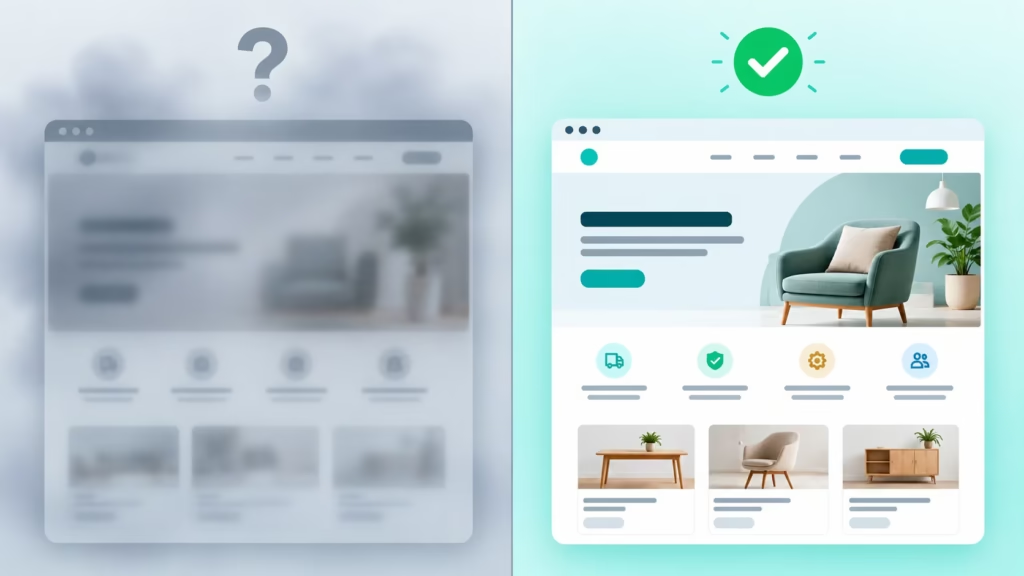
Version A: vague
- Homepage headline: “Smarter workforce solutions for modern teams.”
- One features page listing scheduling, communication, and analytics in a sentence each.
- No mention of industry, company size, or region.
- LinkedIn calls it “HR technology”; an old directory lists it as “payroll software”.
- No schema markup, no customer stories, no named team.
Asked “What does Shiftwell do?”, an AI tool could reasonably answer: “Shiftwell appears to be an HR or workforce management platform.” That answer is not wrong, but it fits hundreds of companies. Asked for scheduling tools for restaurant groups, it has no reason to include Shiftwell at all.
Version B: clear and supported
- Homepage headline: “Employee scheduling software for multi-location restaurant groups.”
- A supporting line: “Build shift schedules from sales forecasts, manage swaps in a mobile app, and catch overtime before it happens.”
- Dedicated pages for forecast-based scheduling, shift swaps, overtime alerts, and point-of-sale integrations, plus a page for restaurant groups with 5 to 50 locations.
- Matching descriptions on LinkedIn, review platforms, and software directories; the old payroll listing corrected.
- Organization and SoftwareApplication schema, with
sameAslinks to official profiles. - Customer stories from named restaurant groups, and articles on reducing overtime in hospitality written by the team.
Now an AI tool has a clear category, a defined audience, specific features, consistent confirmation from other sources, and pages it can cite. It still might not recommend Shiftwell every time. But when it describes Shiftwell, it is far more likely to be right, and the company has a credible case for inclusion when someone asks the right question.
Conclusion: AI visibility starts with being understood
Nobody can promise that ChatGPT or any other AI tool will recommend your business. Anyone who does is guessing.
What you can do is remove the reasons AI gets you wrong. Make your business easy to understand with clear positioning. Easy to distinguish with specific services and a defined audience. Easy to verify with consistent information, structured data, and credible third-party support.
Those same improvements help human buyers too. A website that AI can explain accurately is usually a website a prospect can understand in thirty seconds.
Your turn
Open ChatGPT and ask it what your business does. Then ask it which companies it would recommend in your category.
What industry are you in, and did the answer match how you would describe your business? Share it in the comments. I read every one, and the patterns across industries are often more revealing than any single answer.